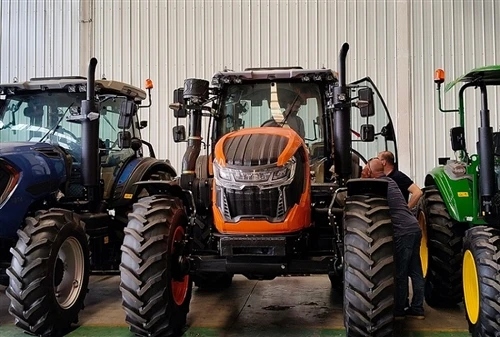
Core Functions
Traction Operations: By attaching different agricultural implements (such as plows, harrows, seeders, transport trailers, etc.), the tractor can perform field operations such as plowing, soil preparation, sowing, fertilizing, harvesting, and transportation.
Power Operations: Using the power take-off (PTO) shaft, the tractor transmits engine power to compatible implements (such as rotary tillers, sprayers, harvesters, etc.) to drive them directly.
Typical Application Scenarios
Soil Preparation: Equipped with reversible plows or disc harrows for soil loosening and leveling.
Sowing and Transplanting: Connecting seeders or rice transplanters to achieve precise sowing or rice transplanting.
Crop Protection and Fertilization: Working with boom sprayers or fertilizer spreaders to control pests and diseases and supplement nutrients.
Transportation Function: Serving as an agricultural transport tool to carry farm supplies and products.
Adaptation to Special Terrain: For example, four-wheel steering tractors are suitable for narrow operations in hilly areas; track-type tractors are suitable for wetlands or heavy clay soils.
Technology Development Trends
Intelligent: Equipped with Beidou/GPS navigation systems to achieve centimeter-level operational accuracy and support unmanned driving.
High Efficiency and Energy Saving: New platforms with high horsepower, continuously variable transmission (CVT), electric or methane power are being gradually promoted.
Multi-Function Integration: Through the three-point hitch system and hydraulic control, implements can be quickly swapped, meeting the full-chain demands of "plowing, planting, managing, and harvesting."