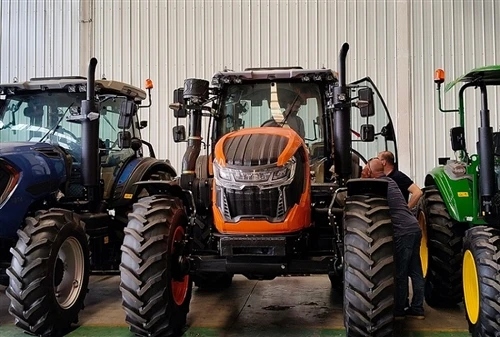
Sri Lanka does not have one single type of farming condition.
During our visit to central Sri Lanka in early September, much of the farmland we saw along the road was relatively dry. But paddy farming presents a very different working environment. Paddy is widely cultivated in Sri Lanka, and seasonal rainfall, irrigation and repeated field preparation can leave some fields heavily waterlogged during cultivation.
To see how the tractor would perform under this type of condition, our local customer arranged a field test in a nearby paddy field.
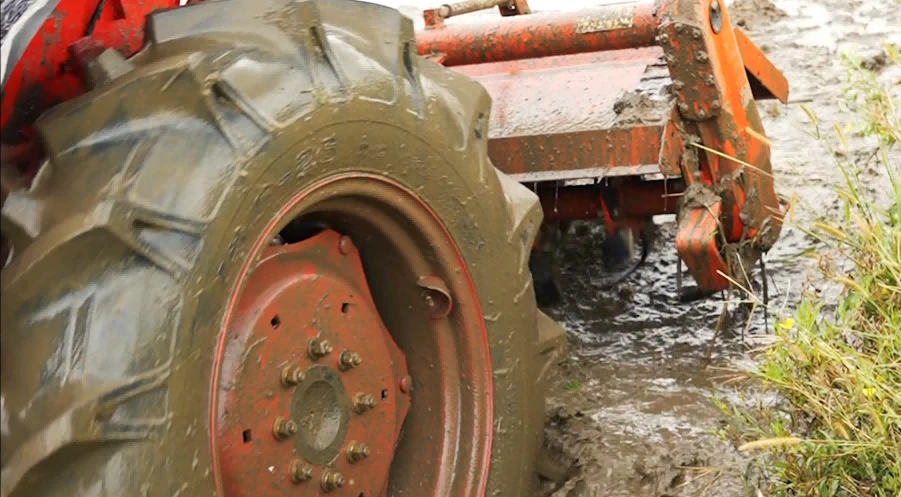
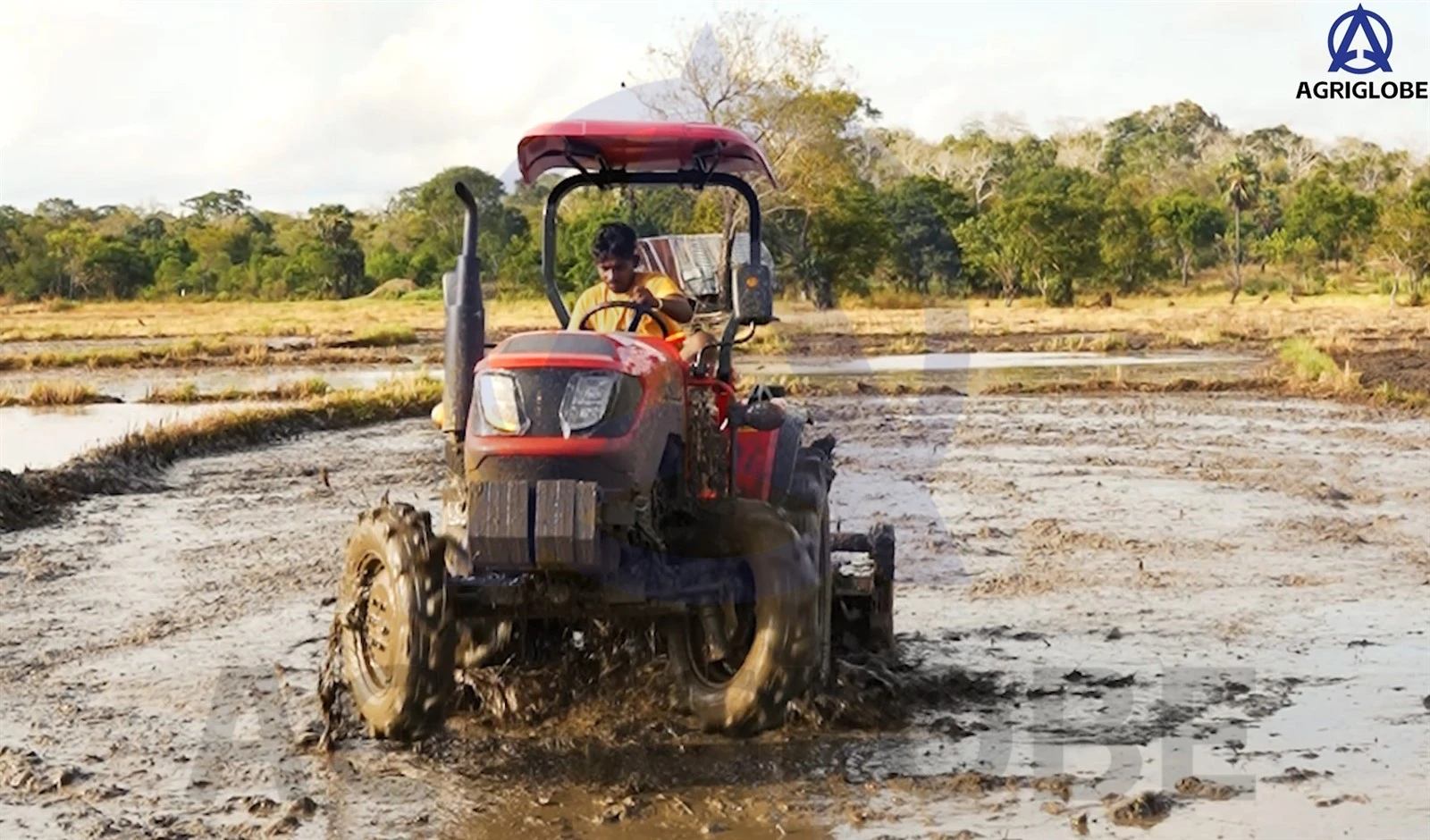
The field was already holding water, and repeated cultivation had turned the upper soil into thick, waterlogged mud. In some areas, the ground was so heavily saturated that the tyres were working through a deep, slurry-like layer rather than firm soil. The tractor had to keep moving through these conditions while operating a rear-mounted implement at the same time.
For this type of work, horsepower matters. But so do traction, tyres, weight distribution, braking, steering and the way the tractor is matched with its implement.
1. Why Does 4WD Matter More in Soft Mud?
On firm ground, a 2WD tractor can rely mainly on its rear wheels for traction.
In a wet field, that becomes harder.
Once the rear tyres begin to sink and spin in soft mud, the engine can still be producing power without moving the tractor forward effectively. With 4WD, the front wheels also contribute to traction instead of only steering the tractor.
That becomes particularly useful when a rear implement is working in the soil and adding resistance behind the machine. In loose or wet soil, a 2WD tractor is also more likely to experience rear-wheel slip than a comparable 4WD tractor.
So if a tractor will regularly work in wet, soft or muddy fields, 4WD is a practical feature to prioritize.
But four driven wheels do not automatically solve every traction problem.
The power still has to reach the ground through the tyres.
2. Why Can a 4WD Tractor Still Slip with the Wrong Tyres?
4WD gives more wheels the ability to drive.The tyres decide how much of that ability can actually be used.
In thick mud, agricultural tyre lugs need to bite into the soil and continue finding grip as the wheel rotates. If the tyre cannot maintain effective contact with the ground, four spinning wheels are not much better than two.
Tyre pressure also matters.
A tyre that is overinflated has a smaller effective contact area with the soil and may increase wheel slip. Proper tyre pressure and suitable tractor ballast work together to improve traction and make better use of the available power.
The 50HP tractor used during our Sri Lankan field test was fitted with 8-18 front tyres and 13.6-26 rear tyres.
That does not mean these sizes are automatically right for every farm in Sri Lanka. Tyre choice still needs to match the tractor's weight, field conditions and the work it will be doing.
This is why asking only:
"Is the tractor 4WD?"
does not tell the whole story.
The next question should be whether the tyres, pressure and tractor weight are suitable for the ground where the machine will actually work.
3. What Do Ballast, Stability and Operator Protection Have to Do with Muddy Field Work?
One of the most visually striking moments during the field demonstration came when the driver accelerated sharply and briefly lifted the front of the tractor.
The movement showed how quickly engine torque, rear-wheel traction and acceleration can shift the tractor's weight toward the rear axle.
During normal field work, however, the important point is to keep that weight distribution under control.
A rear-mounted implement, soil resistance and changes in speed can all affect how much load remains on the front axle. The rear tyres need enough weight to maintain traction, while the front wheels still need sufficient ground contact for steering and, on a 4WD tractor, useful front-wheel traction.
This is where ballast matters.Ballast is not simply extra weight. It is weight placed where the tractor needs it.
Too little front weight can reduce steering control and front-wheel traction, while excessive ballast adds unnecessary rolling resistance and soil compaction. The correct setup depends on the tractor, tyre size, implement and actual field work.
But muddy paddy fields also raise another issue: operator safety.
When the soil surface is covered by standing water and thick mud, the driver may not be able to clearly see changes in ground level, deeper ruts, hidden obstacles or suddenly softer sections of soil. A tractor can therefore encounter an uneven load or a sudden change in attitude with relatively little warning.
For this kind of work, buyers should also pay attention to ROPS, operator protection, tractor stability and correct ballast, rather than focusing only on engine power and traction.
So the practical question becomes:
Is the tractor properly balanced and equipped to remain controllable when the ground underneath it is uneven, soft or difficult to see?
4. Why Are Wet Brakes Useful in Muddy Farm Conditions?
Wet brakes place the braking discs inside an enclosed, oil-immersed system.
For tractors that regularly move through mud, water and field debris, this design keeps the braking components better isolated from the outside working environment. The oil also helps with cooling during repeated braking.
For machines that spend much of their working life moving between farm roads, muddy field entrances and wet farmland, wet brakes are a practical choice for durability and stable braking performance.
5. Why Does Hydraulic Steering Matter More After Repeated Field Turns?
Paddy work is not simply a matter of driving straight across the field.
At the end of each pass, the operator has to slow down, raise the implement, turn the tractor, line up the next pass and lower the implement again.
Mud also increases resistance at the tyres, while the rear implement changes how the tractor feels during a turn.
This is where hydraulic steering becomes less of a specification-sheet feature and more of an everyday operating feature.
The main benefit is simple:
the operator does not have to fight the steering wheel through every low-speed turn.
That difference may sound small when a tractor is tested for five minutes.
After repeated turns throughout a working day, it becomes much easier to understand.
For farms with smaller plots, narrow access routes and frequent headland turns, steering effort is part of tractor usability, not just driver comfort.
6. Why Can Two 50HP Tractors Perform Differently?
Around 50HP came up frequently in the tractor requirements we encountered in Sri Lanka.
But a 50HP label does not tell you how the whole tractor will perform.
Two tractors can both be rated at 50HP while using different engines, transmissions, PTO systems, clutches, tyres and hydraulic systems. Even the engine itself matters: different brands and engine models can have different displacement, torque characteristics and response under load.
That becomes noticeable when a rotary tiller enters heavier soil or thick mud.
The tractor still needs to maintain an appropriate working speed while the PTO continues driving the implement. A suitable gearbox, PTO speed and clutch arrangement can therefore make one 50HP tractor much easier to use for a particular job than another tractor with the same rated horsepower.
Our 50HP configuration uses an 8F+8R transmission, 540/720 rpm dual-speed PTO and dual-action clutch.
Engine and component choice also matter beyond field performance. For an overseas buyer, the availability of spare parts and familiarity with a particular engine or component supplier can affect long-term maintenance just as much as the original specification.
So instead of asking only:
"Is 50HP enough?"
a more useful question is:
"Which 50HP tractor is properly configured for the implement and soil I will actually use?"
Horsepower is the starting point. The engine, transmission, PTO, tyres, hydraulics and implement matching determine how useful that horsepower becomes in the field.
So What Should You Look for in a Tractor for Wet and Muddy Fields?
The Sri Lankan field test reinforced something that is easy to miss when comparing tractor brochures.
A muddy field does not test one specification at a time.
4WD helps more wheels contribute to traction, but the tyres still have to grip the soil. Good tyres cannot compensate for poor weight distribution. Correct ballast helps keep the tractor balanced under load. Wet brakes are better protected from the surrounding muddy environment, while hydraulic steering makes repeated low-speed turns easier to manage.
And even if two tractors both carry the same 50HP label, their engines, transmissions, PTO systems and implement matching can make them behave very differently once they enter the field.
These features work as one system.
That is why a tractor intended for wet and muddy agricultural conditions should not be selected simply by finding the highest horsepower within a budget.
For us, seeing a 50HP tractor actually working through thick, waterlogged mud in Sri Lanka made the difference particularly clear:
the right tractor is not defined by one impressive specification. It is defined by how well the drivetrain, tyres, weight distribution, controls and implement work together in the field.