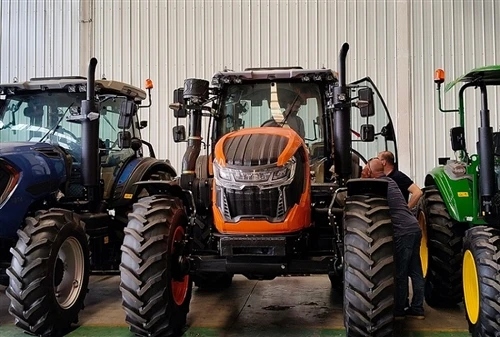
Core Basic Features
High Mobility and Flexibility: Features a small turning radius (some models as small as 2.8–3.5 meters), with some using four-wheel steering or articulated steering technology, allowing flexible operation in narrow and irregular plots.
Good Slope Stability and Safety: Designed with a low center of gravity and reinforced chassis; some models can operate smoothly on steep slopes of 25°–35°, equipped with a rapid braking system (response time <0.5 seconds) and anti-rollover structure.
Strong Passability and Adaptability: Uses an all-terrain travel system (such as high-profile tires, tracks, or triangular tracks) to adapt to complex ground conditions including muddy land, slopes, narrow ridges, and gravel.
Multi-Function Support Capability: Supports various operations like rotary tilling, plowing, seeding, trenching, transporting, and fixed power output; interchangeable implements allow for "one machine with multiple uses."
Intelligent and Automated Configuration: Some high-end models integrate Beidou navigation, unmanned operation, electro-hydraulic control, electronic differential lock, automatic route planning, and other functions, achieving operation precision within 2.5 centimeters.
Lightweight and Modular Design: Particularly suitable for small mountain tractors in southern hills, emphasizing weight reduction (e.g., hand-guided or micro-tillage models weighing around only 20 kilograms), making them easy to handle, and supporting modular quick-change operational components.