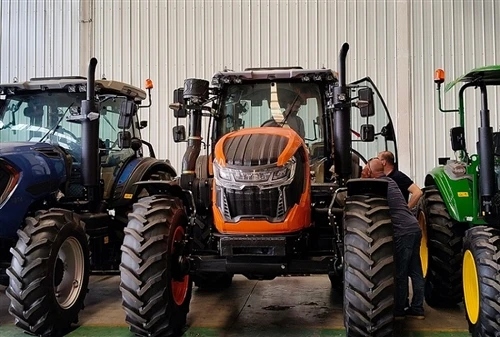
Excellent soil crushing and land preparation effect: The rotary tiller cuts the soil with rotating blades, and its soil crushing ability is significantly better than traditional plowing. A single operation can achieve the soil crushing effect of multiple plowings and harrowings, leaving the surface smooth and without plow furrows.
High operational efficiency: It can complete multiple processes such as plowing, harrowing, and leveling in one go, greatly shortening the cultivation cycle, saving labor and time costs, and helping farmers to seize the optimal farming period.
Improvement of soil structure: Deep plowing can effectively break the soil compaction layer, enhancing soil aeration and water retention capacity. Some models, combined with deep loosening technology, can significantly increase crop yield.
Adaptability and functional expansion
Strong soil and terrain adaptability: Well-suited for paddy fields, drylands, clay soils, and other soil types. When used with matching tractors, it can improve traction performance, reducing wheel sinking and slippage. Crawler-type models are even more suitable for hilly areas, mountainous terrain, and deep muddy paddy fields, achieving dual-purpose use for both wet and dry farming.
Combined operation capability: Modern rotary tillers can easily integrate functions such as seeding, fertilization, mulching, and trenching through component replacement or addition, forming combined operation units and greatly improving production efficiency.
Straw returning function: Can mix surface straw into the soil, increasing soil organic matter, while suppressing weeds and certain pests, and reducing environmental pollution.