One of the first questions we hear from buyers is simple:
"What horsepower tractor do I need for my farm?"
The answer usually starts with farm size, but it should not end there.
Two farms of the same size can need very different tractors. A 100-acre orchard, a rice farm and a sugarcane farm may all call for different machines because the work, implements and field conditions are different.
A practical way to narrow it down is:
Start with farm size → consider the crop and the work → then match the tractor to the implements and field conditions.
Why Tractor Horsepower Matters
Horsepower affects what size of implement a tractor can handle, how comfortably it can work under load, and how much work it can get done in a given time.
Too little horsepower can mean slow field work, limited implement options and a tractor that spends too much time working close to its limit.
But buying more horsepower than you need is not always the safer choice either. A larger tractor costs more to buy and run, and it may be less convenient in orchards, small fields or areas where frequent turning is required.
The goal is not to buy the biggest tractor you can afford.
It is to find a tractor that gives you enough capacity for the work without paying for power you are unlikely to use.
Step 1: Start With Farm Size
Farm size is a useful starting point for narrowing down the horsepower range.
| Farm Size | Starting Horsepower Range | Typical Use |
|---|---|---|
| Small farm: under 50 mu / 3.3 ha / 8 acres | 25–50 HP | Orchards, vegetables, small grain fields, light tillage |
| Medium farm: 50–500 mu / 3.3–33 ha / 8–82 acres | 50–100 HP | Ploughing, rotary tillage, seeding, fertilizing, transport |
| Large farm: over 500 mu / 33 ha / 82 acres | 100–300 HP | Large-scale tillage, subsoiling, wide implements, heavy-duty work |
These ranges are only a first filter.
Once you know the approximate size range, the next questions are more important:
What are you growing? What jobs will the tractor do? What implements will it pull or power?
Those answers can move the horsepower requirement up or down quite a lot.

Step 2: Consider the Crop
Different crops usually mean different field operations and different implements.
| Crop | Typical Work / Implements | General Horsepower Range |
|---|---|---|
| Rice | Rotary tillage, harrowing, paddy preparation | 35–80 HP |
| Wheat | Ploughing, seedbed preparation, seeding, transport | 60–120 HP |
| Sugarcane | Subsoiling, ridging, transport, heavier tillage | 120–200 HP |
| Orchard | Mowing, spraying, rotary tillage, transport | 25–60 HP |
Rice
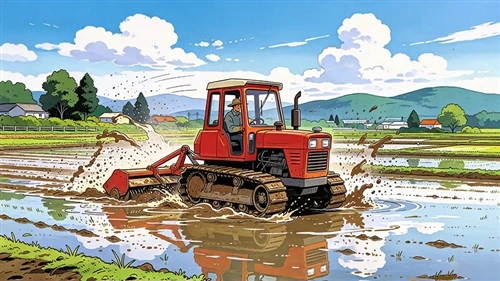
For paddy fields, horsepower is only part of the picture.
Wet-field traction, tire setup, tractor weight and the width of the rotary tiller or harrow can be just as important.
For many general paddy-tillage jobs, 35–80 HP is a useful starting range. Smaller plots may be better suited to a compact tractor, while wider implements and larger fields may justify moving up in horsepower.
Wheat
Wheat farms often expect one tractor to handle several jobs: tillage, seedbed preparation, seeding and transport.
For small and medium operations, the 50–100 HP range covers a lot of common work. Wider seeders, heavier disc harrows or deeper tillage may call for more than 100 HP.
Sugarcane
Sugarcane work tends to be heavier.
Subsoiling, ridging, field transport and heavier cultivation all put more demand on traction and engine power. On larger operations, 100–200 HP or more can make sense.
Here, higher horsepower is not about having a bigger number on the hood. It is usually about handling heavier implements and finishing more work within the available field window.
Orchards
Orchards are a good example of why bigger is not always better.
Row spacing, canopy height and turning room can matter more than maximum horsepower. For mowing, spraying, light tillage and transport, a 25–60 HP compact, narrow or low-profile tractor is often more practical than a larger machine.
What Can Different Horsepower Ranges Do?
25–50 HP: Small Farms and Flexible Work
This range is commonly used for:
orchards;
vegetable farms;
small fields;
light rotary tillage;
mowing and spraying;
light transport.
Typical implements include small rotary tillers, mowers, sprayers, light ploughs and small trailers.
The main advantage here is usually not raw power. It is compact size, lower operating cost and easier maneuvering.
50–100 HP: General-Purpose Farm Work
This is one of the most versatile horsepower ranges.
It can cover a wide mix of jobs, including:
ploughing;
rotary tillage;
disc harrowing;
seeding;
fertilizing;
transport.
Common implements include rotary tillers, disc ploughs, disc harrows, seeders and medium-sized trailers.
For farms that want one tractor to handle several everyday jobs, this is often the range worth comparing most closely.
100–300 HP: Large Farms and Heavy-Duty Work
Once you move into this range, the questions usually change.
It is no longer only about whether the tractor can pull an implement. Buyers start thinking about working width, hectares covered per day, continuous heavy-load operation and larger implements.
Typical equipment may include subsoilers, multi-furrow ploughs, heavy disc harrows, large seeders and heavy trailers.
This horsepower range is better suited to large farms, contractors and operations where productivity over a limited working window matters.
The Implement Often Decides the Horsepower
Farm size tells you roughly where to start.
The implement often tells you where to finish.
Take two farms of the same size. One may only need a compact tractor for orchard maintenance, while the other may need much more horsepower to pull a wide subsoiler or heavy plough.
That is why we normally look at the implement's:
working width;
PTO requirement;
draft requirement;
hydraulic demand;
lifting weight.
Then we work backward to the tractor.
This is also why a question like "Is 80 HP enough?" cannot always be answered without knowing what the tractor will actually be asked to do.
A Simple Way to Estimate Horsepower
A useful starting point is:
Estimated tractor horsepower ≈ implement requirement × field-condition factor × reserve
For example, suppose an implement is normally matched with a 60 HP tractor.
If the farm has relatively heavy soil and you also want some reserve for tougher conditions or future use, it may make more sense to compare tractors around 70–80 HP rather than choosing a machine right at 60 HP.
The important point is not to treat this as an exact engineering formula.
The idea is simpler:
Start with what the implement needs, then allow for the actual conditions in which it will work.
The implement manufacturer's recommendations, PTO requirements, working width and local soil conditions should still be checked before making a final choice.
Two Common Horsepower Mistakes
Buying Too Much Tractor
"Bigger gives me more options" sounds reasonable, but oversizing can create its own problems:
higher purchase cost;
higher fuel and maintenance costs;
poorer maneuverability in small fields;
unnecessary size and weight for orchard or light-duty work.
Some reserve is useful. Paying for horsepower you may never use is not.
Buying Too Little Tractor
Undersizing usually creates the opposite problem:
limited implement choices;
poor performance under heavy load;
slower field work;
less room to upgrade to larger implements later.
If you expect the farm to expand or plan to add larger implements in the next few years, that should be part of the decision from the beginning.
FAQ
What horsepower tractor do I need for my farm?
As a starting point:
under 50 mu / 3.3 ha / 8 acres: 25–50 HP;
50–500 mu / 3.3–33 ha / 8–82 acres: 50–100 HP;
over 500 mu / 33 ha / 82 acres: 100 HP and above.
But farm size only gives you a rough range.
Your crop, implements, soil and type of work should determine the final choice.
Which tractor is best for a paddy rice field?
For paddy work, look beyond horsepower.
4WD, wet-field traction, tire setup, tractor weight and rotary-tiller matching all matter.
For many common paddy-tillage jobs, 35–80 HP is a practical starting range. Smaller fields may suit a more compact tractor, while larger fields or wider tillage equipment may require more power and traction.
Not Sure Whether You Need 50 HP, 100 HP or 160 HP?
Before asking for a tractor quotation, it helps to prepare four pieces of information:
farm size, main crops, soil or terrain, and the implements you plan to use.
With those details, it is much easier to narrow down not only the horsepower, but also the tire setup, PTO, hydraulics, ballast and implement configuration.
Ling Ke Industry Group supplies 25–300 HP Agriglobe tractors and matching agricultural implements. If you are not sure which horsepower range fits your farm, send us your working conditions and planned implements, and we can help work out a suitable configuration.